
EDF Energy Reviews, Prices & Tariffs
The BT Group was founded in 1846 and is the longest- established telecoms company operating in the UK.
- Quality Customer Service.
- Freedom to choose the right deal for your business.
- Quality Customer Service.
- Quality Customer Service.
Why Compare Business Broadband Prices?
We offer a quick and easy way to compare business broadband prices with no obligation to switch. You might be overpaying for a slow connection or using outdated equipment.
With just a few clicks, you can see which providers and speeds are available to you. You have nothing to lose, except perhaps your slow, old broadband connection!
We have partnered with leading business broadband providers in the UK, including Vodafone, Daisy, EE, Virgin Media, and O2. We are also proud to be an authorised BT business partner.
Business Leased Line Deals
BT Business

76Mbps
BTNet Leased Line
Compare live BT broadband deals
online and start saving today.
- 5-hour fault fix SLA
- 24/7 customer support
- Cisco Meraki security
- Private connection, not shared
- Latency guarantee
- Guaranteed speeds – even during peak hours
- Regular security patch updates
Daisy Communications

10Gbps
- Next day fault fix SLA
- UK customer support
- DDoS security
- Low 8:1 shared connection
- Static IP address
- Equal download & upload speeds
- Minimum speed guarantee
Daisy Communications

10Gbps
- 6-hour fault fix SLA
- 24/7 customer support
- DDoS security
- Private connection, not shared
- Guaranteed speeds – even during peak hours
- Equal download & upload speeds
- Static IP address
BT Business Broadband And Phone Bundles -Our Bestsellers
BT Business
76Mbps
BTNet Leased Line
Compare live BT broadband deals
online and start saving today.
- 5-hour fault fix SLA
- 24/7 customer support
- Cisco Meraki security
- Private connection, not shared
- Latency guarantee
- Guaranteed speeds – even during peak hours
- Regular security patch updates
Daisy Communications
10Gbps
- Next day fault fix SLA
- UK customer support
- DDoS security
- Low 8:1 shared connection
- Static IP address
- Equal download & upload speeds
- Minimum speed guarantee
Daisy Communications
10Gbps
- 6-hour fault fix SLA
- 24/7 customer support
- DDoS security
- Private connection, not shared
- Guaranteed speeds – even during peak hours
- Equal download & upload speeds
- Static IP address
BT Business Broadband Deals
BT Business
76Mbps
BTNet Leased Line
Compare live BT broadband deals
online and start saving today.
- 5-hour fault fix SLA
- 24/7 customer support
- Cisco Meraki security
- Private connection, not shared
- Latency guarantee
- Guaranteed speeds – even during peak hours
- Regular security patch updates
Daisy Communications
10Gbps
- Next day fault fix SLA
- UK customer support
- DDoS security
- Low 8:1 shared connection
- Static IP address
- Equal download & upload speeds
- Minimum speed guarantee
Daisy Communications
10Gbps
- 6-hour fault fix SLA
- 24/7 customer support
- DDoS security
- Private connection, not shared
- Guaranteed speeds – even during peak hours
- Equal download & upload speeds
- Static IP address
Need help deciding?
Call our experts to find out what you really need for your business.
Free call on XXXXXXXXX
Choosing Your BT Business Broadband Deal
|
Broadband Provider |
Speeds Available (Mbps) |
Features |
Trustpilot Rating |
|
BT Business Broadband |
76 to 900 Mbps |
Guest wifi, minimum speed guarantee and hot spots |
Not Available |
|
BT Business Broadband |
76 to 900 Mbps |
Guest wifi, minimum speed guarantee and hot spots |
Not Available |
|
BT Business Broadband |
76 to 900 Mbps |
Guest wifi, minimum speed guarantee and hot spots |
Not Available |
Business Electricity Tariffs
There are several types of business electricity tariff types that businesses can choose from. Each has its merits, as well as aspects to consider. Our Energy Tariff guide goes into more detail, however we'll provide a summary below:

-
Fixed-Rate Tariff
The most popular business electricity tariff for those who want to lock in their rates to avoid future increases. You can fix your rates from 1 year up to 5 years. This means that if wholesale prices increase or decrease you will have the security of paying the same unit rate and standing charge for the agreed amount of time.
-
Variable-Rate Tariff
This can change each month based on the wholesale electricity prices. This means businesses more open to risk can benefit from price drops but may pay more during times of increasing rates.
-
No Standing Charge Tariff
Businesses that operate part-time or seasonally can benefit from no standing charge tariffs. However, they are not for every business as they often come with higher unit prices than other tariff types.
-
Deemed Tariff
Businesses that have not signed a contract with an electricity supplier when moving in to their premises will be placed on a deemed tariff by default. You electricity supplier will be the default supplier for your region, and the rates may not be the most beneficial to your business. Typically, these are the most expensive on the market.
-
Rollover Tariff
Businesses that have failed to agree a new business electricity contract can be placed on a rollover contract for a fixed period - usually a year. These rates are binding, and may not necessarily be the best rates for your business, so it is important to compare prices before your contract ends.
-
Green Tariff
Green tariffs are a tariff type available to large and small businesses that want to source their power from sustainable and renewable sources, and as a result many suppliers offer green tariffs.
-
Smart Export Guarantee (SEG) Tariff
Smart Export Guarantee (SEG) tariffs are for customers that generate their own power using renewable sources such as solar and wind. It is a government-backed tariff that pays customers for every kWh that they produce for the grid. These used to be known as Feed-In Tariffs.
-
Flexible Tariff
Organisation that use a large amount of electricity have the option to buy their electricity in advance using a flexible tariff. This has the benefit of access to wholesale electricity prices and saves on some retailer costs.
-
Pass-Through Tariff
A pass through tariff is more complex than other tariff types. A pass-through tariff separates your bill into two segments: the fixed energy element, which stays the same for the duration of your contract, and the non-fixed, non-energy element which is made up of the additional costs the supplier would ordinarily pass on to the customer; these vary through the year. These tariffs are most suited to electricity buyers that want to be in total control of their bill.
-
Cheapest Business Electricity Tariffs
The cheapest business electricity tariff will come down to a variety of factors, such as annual usage, location and current wholesale prices. We looked at our panel of business electricity suppliers for the cheapest tariff for a business based in London, using 25,000 kWh of electricity a year and signing to a one-, two- and three-year fixed contract.
Choosing Your BT Business Broadband Deal
|
Broadband Provider |
Speeds Available (Mbps) |
Features |
Trustpilot Rating |
|
BT Business Broadband |
76 to 900 Mbps |
Guest wifi, minimum speed guarantee and hot spots |
Not Available |
|
BT Business Broadband |
76 to 900 Mbps |
Guest wifi, minimum speed guarantee and hot spots |
Not Available |
|
BT Business Broadband |
76 to 900 Mbps |
Guest wifi, minimum speed guarantee and hot spots |
Not Available |
Business Electricity Quotes for Small Businesses
Small businesses (SMEs) need to stay in control of their electricity bills. Even with Ofgem extending protections to those that are considered micro businesses, it can be challenging to find the time to secure great deals on business electricity prices.
According to Ofgem, a non-domestic consumer is defined as a micro business if it meets one of the following criteria:
- Employs fewer than 10 employees (or their full-time equivalent) and has an annual turnover or balance sheet no greater than €2 million (£1.7 million as of August 2022), or
- Uses no more than 100,000 kWh of electricity per year, or
- Uses no more than 293,000 kWh of gas per year.
The benefit of being a micro business electricity user is that you can give termination notice anytime and secure better business electricity prices. Suppliers also have to send your renewal notices.
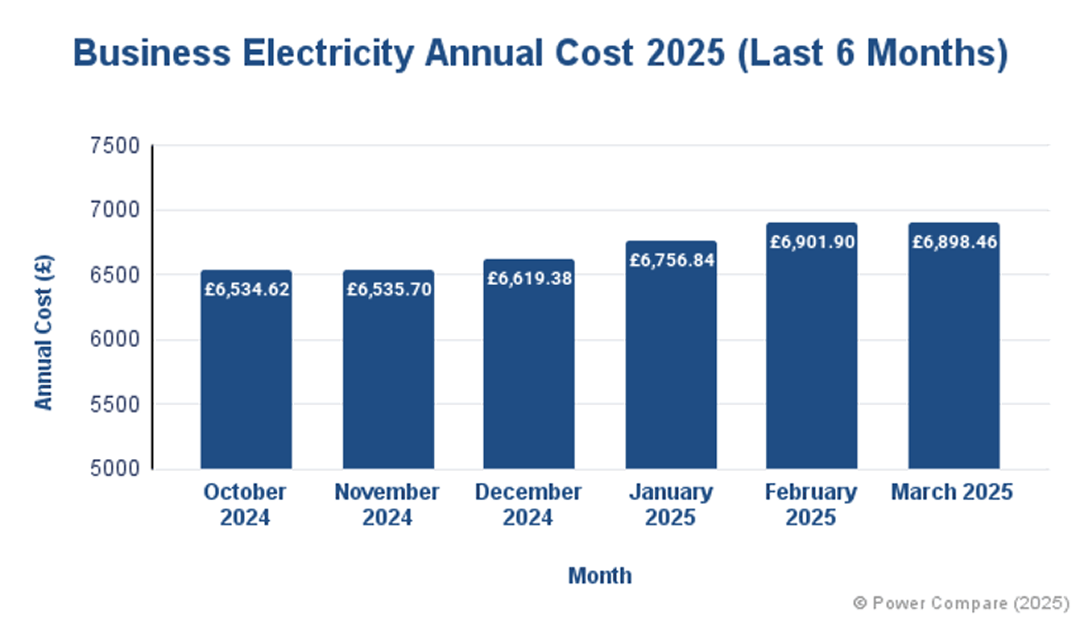
Are Business Electricity Rates Rising in 2025?
Business electricity unit rates have been rising slowly over the last five months. October 2024 was the lowest average business electricity rate since prices peaked in September 2022, and since then, the unit rate has increased by 1.52p per kWh (or 6%). February 2025 was also the first month since 2023 when the year-on-year average UK unit rate was higher, and we see this continues in March 2025. This is down to many economic and geopolitical factors, as well as being seasonal demand-driven.
Business electricity unit rates have been rising slowly over the last five months. October 2024 was the lowest average business electricity rate since prices peaked in September 2022, and since then, the unit rate has increased by 1.52p per kWh (or 6%). February 2025 was also the first month since 2023 when the year-on-year average UK unit rate was higher, and we see this continues in March 2025. This is down to many economic and geopolitical factors, as well as being seasonal demand-driven.
How to start saving
Getting a great deal is easy. Compare, sign, and track everything online.
-

1.Compare the most competitive offers. Choose from top UK suppliers
-

2. Compare the most competitive offers. Choose from top UK suppliers
-

3. Track your switch and manage all your business essentials in one place – MyHUB.
Sky Broadband Business Summary
Here's a quick snapshot of Sky Business Broadband.
- Great customer service ratings
- Great customer service ratings
- Great customer service ratings
- Great customer service ratings
- Great customer service ratings
- Great customer service ratings
- Great customer service ratings
- Great customer service ratings
- Great customer service ratings
- Great customer service ratings
Business Electricity FAQs
-
When is the best time to switch business electricity?
The best time to switch will often depend on your current business electricity contract. When you enter your renewal window, you can switch without paying an exit fee. If you’re unsure when you can switch, you can find your renewal window in your business electricity contract.
If you’re currently on out-of-contract rates, you can switch at any time. You should compare business electricity prices as soon possible as out-of-contract rates are often some of the most expensive around.
-
Can I cancel my business electricity contract early?
Although it is possible to cancel your business electricity contract early, it could prove costly.
All business electricity contracts will incur an exit fee if you cancel your contract outside of your renewal window. The exact exit fee will vary from supplier to supplier. However, it is often the remaining cost of your contract.
-
How long does it take to switch business electricity suppliers?
Under Ofgem’s Faster Switching Guarantee, your switch should take no longer than five working days once you’ve selected your chosen tariff. If you’re new to premises or you require a new meter, the switch may take longer.
-
What is a half hourly meter?
Half hourly meters provide the most accurate meter readings available to large electricity consumption businesses.
Any business with a maximum demand of more than 100 kWh or greater in any 30-minute period is required to install a half hourly meter by law. If you have a maximum demand of more than 70 kWh in a half-hour period, you can also install a half hourly meter.
As the name suggests, a half hourly meter provides automatic meter readings every 30 minutes. This offers businesses the most accurate billing available as you will not be relying on estimated bills.
-
Small Business vs Micro Business Electricity Rates
According to Ofgem, a non-domestic consumer is defined as a micro business if it meets one of the following criteria:
- The business employs fewer than 10 employees (or their full-time equivalent) and has an annual turnover or balance sheet no greater than €2 million, or
- The company uses no more than 100,000 kWh of electricity per year; or
- The business uses no more than 293,000 kWh of gas per year.The main benefit of being defined as a micro business rather than a small business is that you can give a termination notice at any time during your contract which means you can always shop for the best deal.
-
What is the Energy Bill Discount Scheme?
The Energy Bill Discount Scheme (EBDS) offers companies varying levels of discount on their business electricity between April 2023 and March 2024. You don’t need to apply for the discount and you can still secure a fixed-rate deal.
- Normal consumption businesses - if unit rates go beyond 30.2p/kWh the EBDS kicks into a maximum discount of 1.961p/kWh.
- Electricity-intensive businesses - if unit rates go beyond 18.5p/kWh the EBDS kicks into a maximum discount of 8.9p/kWh.
-
Are Business Electricity Prices Cheaper With Fixed Or Variable Tariffs?
There are two main types of business electricity tariff available. Some suppliers offer more complex blended contracts, but all of them will consist of either fixed or variable elements.
Here are the key things you need to know about both types:
Fixed Tariff Business Electricity Contracts:
- Up to 5 years available, although 1-3 years is the most popular
- Fixed unit price even if wholesale prices increase
- Typically cheaper electricity rates than variable tariffs
- Tied into a contractVariable Tariff Business Electricity Contracts:
- Unit price could change month to month
- Cheaper than deemed or out-of-contract rates
- Usually more expensive than fixed-rate tariffs
- Not usually locked into a long-term contractEach contract has its benefits and is down to the individual circumstances of the business. Most businesses will choose a fixed contract when they switch business electricity as it tends to be much easier to manage in terms of expected cash flow.
-
Understanding Your Renewal Quote
Business electricity prices on your renewal can be more expensive than current market rates. Long gone are the days when it’s easier to pay more and let your contract rollover. We have made it easy to find great prices. The ability to switch business electricity suppliers entirely online allows you to get a great deal whenever you like.
We may even be able to negotiate better business electricity rates with your current supplier so you only need to be transferred onto a new tariff.
-
How To Identify Your Business Electricity Meter
When it comes to knowing what kind of business electricity meter is installed on your premises, it's worth knowing that, broadly speaking, there are two main types of business electricity meter.
Many businesses are using standard meters and larger businesses are using half-hourly meters. You can tell what type of meter you’re on based on your MPAN (Meter Point Administration Number). This number can be found on a recent business electricity bill or on your actual meter box.
- If your supply number starts with a 00 you have a Half Hourly meter.
- If your supply number starts with 03 you have Standard Meter.
- If your supply number starts with 04 you have an Economy 7-meter
- If your supply number starts with 05-08 you are Maximum Demand (MD) customer
A regulation called P272 was implemented on 1 April 2017 which means all 05-08 customers are now billed on a half-hourly basis.
Knowing what your meter type is made comparing electricity prices much easier as not all suppliers are set up to handle Half Hourly customers. Some niche suppliers only deal with half-hourly customers and won’t deal with SMEs on 03-04 profile classes. You will need to be aware of this when you switch business electricity supplier.
Despite a push by suppliers to get all customers on smart meters, many smaller suppliers are still not set up to deal with smart meters. If you would like to remain on a smart meter, you should check that your new supplier supports them before you switch business electricity.
It could be that you need a new meter installed, we offer free business electricity meter installation in some cases.