What's on this page
Share this article


There are five practical ways to take a card payment, and the right one depends on where your customers are when they pay: standing in front of you, on the end of a phone, or on your website at midnight.
This guide covers all five, what each one requires to get going, and how to pick between them.
What you need before you can take a card payment
Whichever method you choose, the money follows the same path: your customer pays, a payment provider processes the transaction, and the funds land in your business bank account a day or two later.
What you need to set that up is an account with a payment provider. There are two shapes this comes in.
A payment service provider gives you an account within minutes and takes a percentage of each sale. There is usually no contract, no credit check worth the name, and no monthly minimum. This is how most small businesses start, and for many it is where they stay.
A merchant account is your own account with an acquiring bank, arranged through a provider. It takes longer to set up and involves underwriting, but the rates are usually lower once you are turning over meaningful volume.
If you are doing under roughly £5,000 a month in card sales, the simplicity of a payment service provider usually outweighs the rate difference. Above that, the rate starts to matter more than the convenience.
The five ways to take a card payment
|
Card machine |
A fixed counter or till point |
A terminal from a provider |
|
Portable reader |
Table service, markets, mobile trades |
A small reader, paired to a phone or tablet |
|
Your phone, no reader |
Occasional or low-volume takings, one-off jobs |
An NFC phone and a provider app |
|
Over the phone |
Bookings, deposits, trade and account customers |
A virtual terminal from your provider |
|
Online |
A website, or invoices you send out |
A checkout or a payment link |
Most businesses end up using two of these. A café takes cards at the counter, and nothing else; a plumber takes them on the doorstep and by phone; a shop with a website needs the counter and the checkout.
 call our payment experts 01204 471180
Taking card payments in person
As the UK is digital-first when it comes to payments, here's how you start taking payments in person.
With a card machine or portable reader
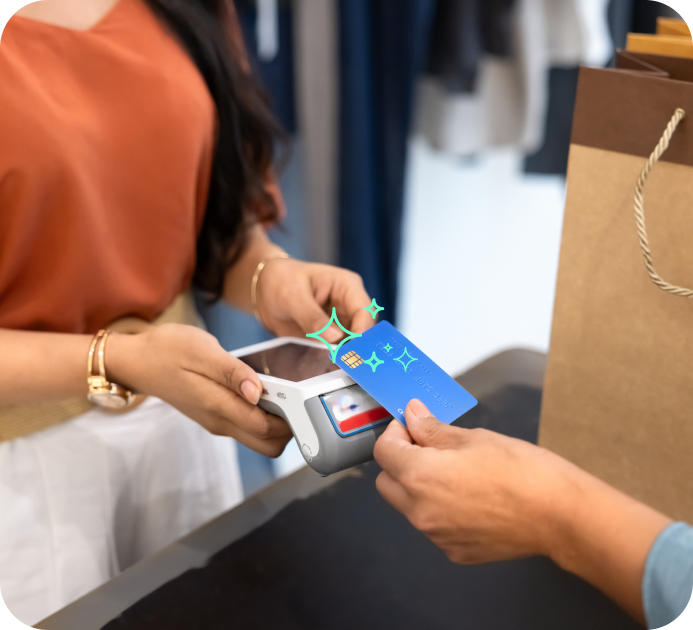
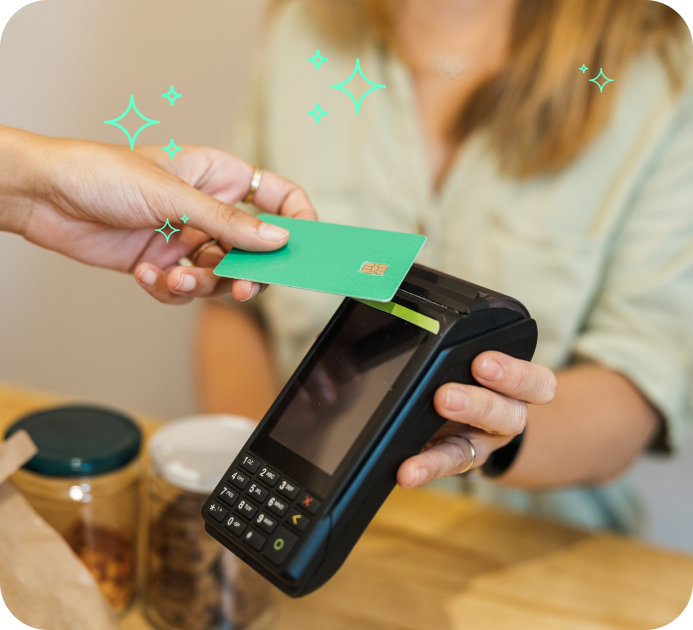
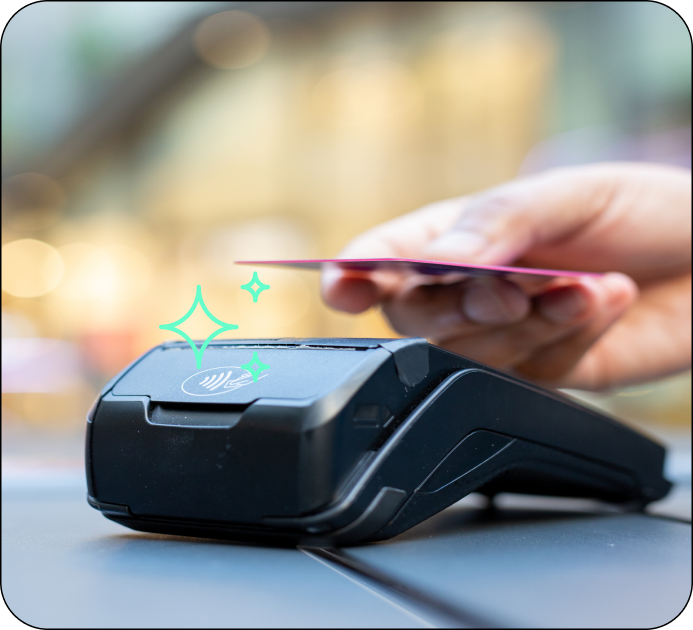
The familiar route. A countertop terminal sits by the till; a portable reader travels with you and pairs to a phone or tablet over Bluetooth. Both accept chip and PIN, contactless cards and mobile wallets.
This is the right choice at any real volume: the per-transaction rates are lower than app-only alternatives, the hardware is built for constant use, and you are not relying on a phone battery lasting the shift. How card machines work and what they cost.
With your phone and no card reader at all
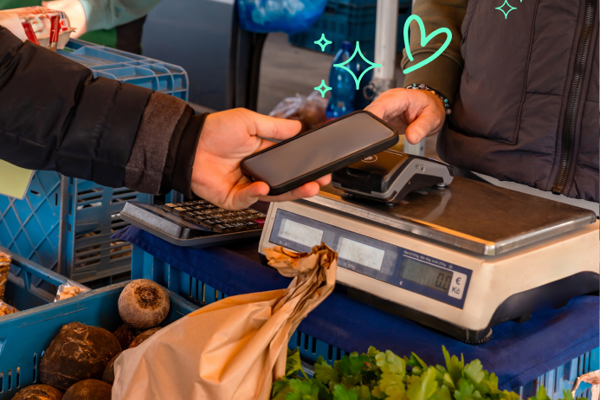
This is the part that has changed, and many businesses have not caught up with it. Modern phones have the same contactless chip a card machine uses. With the right app, your phone becomes the terminal; the customer taps their card or watch against the back of your handset, and that is the payment taken.
No reader, no hardware cost, no delivery wait. It works on recent iPhones and on most NFC-enabled Android handsets, and a good number of UK providers now support it. Transaction fees generally run from a little over 1% to around 3%, depending on the provider and whether you pay a monthly fee for a lower rate.
The trade-offs are real, though. It takes contactless only, so it is capped by whatever contactless limit applies to that customer, and it ties up the phone you also need for everything else. For a tradesperson taking a payment at the end of a job, or a stallholder doing a weekend market, it is close to ideal. For a shop doing two hundred transactions a day, it is not.
Taking card payments over the phone
Taking a card over the phone is entirely legal in the UK and completely routine for trades, bookings and account customers. It is done through a virtual terminal, a secure page from your provider where you key in the customer's details while they read them out.
What matters is how you handle the data, because a phone payment puts card details into your hands in a way a tap never does. Three rules cover most of it:
- Never store the security code: The three digits on the signature strip must not be kept after the payment is authorised. Not on a notepad, not in a spreadsheet, not in your booking system.
- Keep card details out of call recordings: If you record calls, card numbers read aloud end up in the archive. Pausing the recording manually works right up until someone forge is why most providers now offer masking that stops the details reaching the recording at all.
- Do not write numbers down: If you need to take details before you can process them, the answer is a provider feature that captures them securely, not a Post-it that goes in the bin at five o'clock.
A payment taken without the card present carries more fraud risk than one tapped in front of you, and providers price it accordingly. Expect a slightly higher rate on phone transactions than on face-to-face ones.
Taking card payments online
You do not need a website to take a payment online. There are two routes.
- A payment link is a one-off link you send by email or text: The customer clicks, pays, and you get notified. It costs nothing to set up, it works from your phone, and for anyone who invoices rather than sells from a shelf, it is usually the fastest way to get paid. Most providers include it as standard.
- A checkout is the full version: a payment page built into your website so customers pay as part of buying. If you sell online, this is the one you need, and your provider gives you either a plugin for your website platform or a hosted page their system handles.
Either way, the money arrives the same way it does from a card machine. When card payments actually reach your account.
What the contactless limit change means for you
On 19 March 2026, the Financial Conduct Authority removed the £100 regulatory cap on contactless payments. That cap had been in place since 2021, having risen from £45 and, before that, £30.
It has not been replaced with a higher number. It has been removed, and banks and payment providers now set their own limits based on their own fraud controls. Customers may in time be able to set their own.
What that means in practice for a business taking payments today is less dramatic than the headline. The British Retail Consortium expects most banks to hold their existing limits at first, and terminals need updating before higher contactless payments can actually go through. So the sensible position is: do not assume a customer can tap for £300 yet, but expect the ceiling to start moving, unevenly, bank by bank.
If you are choosing a setup now, it is one more reason to ask a provider how their terminals handle limit changes rather than assuming the answer.
Which method fits your business?
|
Shop, café or salon |
Countertop card machine |
A payment link for deposits and orders |
|
Restaurant or pub with table service |
Portable readers |
Nothing, usually |
|
Mobile trade — plumber, electrician, groomer |
Your phone, no reader |
Phone payments for deposits |
|
Market or event trader |
Your phone, or a portable reader |
Nothing |
|
Salon, clinic or garage taking bookings |
Card machine |
A virtual terminal for deposits |
|
Anyone who invoices |
Payment links |
A virtual terminal for chasing |
|
Online seller |
Checkout on your site |
A reader, if you ever sell in person |
Ready to take action?
Understanding what VoIP is and how it works is the first step. The next is finding the right system for your business.
Love Business lets you compare business phone line deals from trusted UK providers, including hosted VoIP packages from BT, Daisy Communications, Virgin Media Business, and more. See what is included, compare pricing, and switch in a few clicks.
If you also need to upgrade your broadband ahead of the switch, compare business broadband deals here.
You are in control.
-
Can I take card payments on my phone without a card reader?
Yes. Recent iPhones and most NFC-enabled Android phones can accept contactless cards and mobile wallets directly through a provider's app, with no separate reader. The customer taps their card against the back of your phone. It takes contactless payments only.
-
Is it legal to take card payments over the phone?
Yes, and it is standard practice for trades, bookings and account customers. You must not store the security code after the payment is authorised, and card details must not be left sitting in call recordings.
-
What do I need to start taking card payments?
An account with a payment provider and a business bank account for the money to land in. Depending on the method, you may need no hardware at all.
-
What is the contactless limit in 2026?
There is no longer a single regulatory limit. The FCA removed the £100 cap on 19 March 2026, and banks and payment providers now set their own. Most held their existing limits initially, so the amount a customer can tap still varies by their bank.
-
Do I need a merchant account?
Not to get started. A payment service provider account is quicker to open and has no real minimum. A merchant account usually works out cheaper once your card takings are consistently past a few thousand pounds a month.
-
Can I charge customers a fee for paying by card?
Not for consumer debit and credit cards, surcharging those has been banned in the UK since 2018. Rules differ for commercial cards, so check with your provider before adding any fees.
-
How quickly do I get the money?
Usually, the next working day, though it varies by provider and by the plan you are on.